Wednesday, May 12, 2010

They're Not All Bad

 I've been pretty harsh on Austria. Sure, a lot of things that Austrians do drive me crazy (to keep this from becoming a rant I won't list anything here), but I've met some great people and had some very gemütlich experiences lately.

I give business English lessons once a week to a man named Helmut who is really, really nice. I knew he and his girlfriend, Elisabeth, liked me when they designated a pair of houseshoes just for me at their apartment (where I meet with Helmut). They cranked up the niceness an extra notch by inviting me, with a group of their friends, to the white wine country in the south of Styria. 
I learned a lot that weekend: when an Austrian "invites" you to do something it means they're going to pay for everything (hotel, food, wine... even cake), a "Buschenschank" is a Styrian restaurant that produces all of their own food and only serves cold dishes, "Grauburgunder" is Pinot Grigio, and the word for this windmill-type contraption, which I've since forgotten but is supposed to make a loud noise to scare off birds. 

I also learned that I'll be incredibly tired the next day if I start with a wine tasting at 4 PM and drink with a bunch of middle aged Austrians until 2 AM.

There are lots of little family-owned wineries throughout this area, and we stayed in the guestrooms of a smaller one (named Jaunegg) and toured a bigger one. This is where we took what Elisabeth called our "Familie Foto." This reminded me of "Mr. Sunday,", my boss from the steel factory, and how when he wasn't googling pictures of the world's largest cat to show me at work or eagerly posing to have his picture taken as below, he and his wife were having me over for dinner and referring to their parents as my Oma and Opa.


Fulbright offered to match us Americans up with Austrians who had had Fulbrights in the past, so a few weekends later I spent the day with Lisbeth, who went to the US in the 70s (on a BOAT), and her husband Luis. We ate lunch at a really nice restaurant outside and celebrated "Spargelzeit" ("asparagus time"... no joke) by all ordering dishes with asparagus- my favorite!


Afterwards we drove to Luis' brother's farm, which was full of chickens, pigs, and this sweet calf, but they very sweetly made a detour into Slovenia (we were near the border) because I mentioned that one of my great-grandparents was Slovenian. 

Then we went to eat cake at their country house and enjoyed this view.

See, Austrians are nice! It takes a much longer time to get to know them than it does with Americans, but Austrians seem to form a few close friendships and keep the for life. A lot of kids in the 8th form (seniors) have had the same friends since kindergarten. This means it's not always the easiest place to integrate into, but I've been lucky enough to find some really kind people.

Monday, May 10, 2010

My Yugoslav Tour Diary Part 2

After successfully making it past the Croatian border on try #2 I was able to go out and enjoy Zagreb. Unfortunately I had to do this alone for a few hours, because it turns out that most cell phones with Austrian SIM cards don't work in Croatia and I had no way of getting ahold of the others. Sigh.
So I decided to walk around and see the city and hopefully bump into the others. I didn't find them, but I was pleasantly surprised at how much I liked the Croatian capital. Everyone had said, "Don't go to Zagreb, go to the coast!" (which I'm doing in June!), but all four of us really liked the city. It was like a mini-Vienna stuck in a 1990s fashion time-warp (more about that later), and I was completely fascinated by everything I learned about it. Here's a smattering of those things:

1. Zagreb is really cute! The buildings were beautiful and stately, and it looked like a mini-Vienna. though places like "Marshal Tito Square" were a reminder that you definitely weren't in Austria anymore. The city was really green thanks to a series of inner-city squares full of trees and flowers nicknamed the "Green Horseshoe."


2. Zagreb is stuck in a 1990s fashion time-warp (this time-warp only pertains to fashion... I didn't encounter any landmines or relatives/refugees eating things like rocks). The 19th century architecture provided a pretty stark contrast to all the Adidas track-suit clad Croatian men (jacket without and undershirt AND the breakaway pants), who used even more crunchy hair gel than most Europeans and zipped around on rollerblades. I was lucky enough to get a picture of this lovely lady, whose picture I'll make extra-large to illustrate the Zagrebian fashion climate and serve as a reminder to all of us that sometimes leggings are transparent.


3. Catholicism is alive and well in Croatia. The cathedral (the twin spires) was full of worshipers on Easter Saturday, as were various other churches, including this outdoor chapel. This is at least partially an outgrowth of post-Yugoslav nationalism, as Croatians use Catholicism to distinguish themselves from the Orthodox Serbs. 
 

They also used this life-size replica of the Last Supper as a backdrop to take pictures of their children with.


St. Mark's Church, which was next door to the Croatian Parliament (I didn't take a picture because I wasn't sure if that was allowed and, as much as I enjoyed my little detour, didn't want to get sent home again), had and awesome roof, 

 
and St Catherine's, which is "Zagreb Baroque" (plain on the outside and dripping with clouds, cherubs, the color pink, and plaster swirls on the inside) was beautiful at sunset.


4. Zagreb is a great place to sit outside and regale your friends with stories of the time you almost went to Croatian prison. This really cute street, which was full of outdoor cafes and bars, is where Emily, Matt, Amber, and I celebrated my arrival over a few beers (I found them at the hostel that night).


5. If you go to the fountain in the main square you can have a seance, because according to the free guide "Zagreb Step by Step" that's where witches used to meet.


6. Croatian is a funny language. In another attempt to distance themselves from the Serbs (the official language of Yugoslavia was Serbo-Croatian), they're adopted a lot of new, supposedly more Croatian words. Like many other European languages they use slightly modified English words, but they also use the "-ski" ending for tons of words (I thought that was more of a northern-Slav thing). As a result there were places like the "Studentski Centar" in the city, and after those "few beers" I thought it was perfectly acceptable to say "excuski meeski" to someone when trying to get off the tram.


7. Croatia has at least one awesome national park. On Easter, because EVERYTHING was closed except the park and because I had my heart set on it (thanks to Rick Steves), we took a daytrip to Plitvice National Park. It was just as awesome as it looked on PBS. 
Rick Steves described it as Niagra Falls diced up and sprinkled across the Grand Canyon (what a wordsmith), and I have to say that he was right. We were impressed from the start and were happy enough to take pictures of things like this


but it just kept getting better and better
 
and better.
 

We walked across the lakes, which are terraced and have some ridiculously high amount of calcium, giving the falls a chalky white color, on wooden trails that wound under waterfalls and over bright blue water and crystal clear water. Because fishing isn't allowed there are tons of trout.
And because many Europeans are fascinated by American Westerns and this landscape apparently looks like the American West to them (????), many Spaghetti Westerns were filmed here, including every German's favorite "Der Schatz im Silbersee."

It should be noted that this trip wouldn't have been possible without Rick Steves, whose book helped up figure out the bus schedule and how to get into the park, which was confusing. We're going to write him a haiku of thanks.


8. The most interesting thing to see in Maribor, Slovenia (where I stopped on my way back to Graz) is this 400 year old vine, which still produces fruit. Yep, I said MOST interesting. 


9. Ptuj (seriously pronounced "pah-tooey") is much cuter. Every year for Karneval (Mardi Gras) the men of the town dress up in these costumes, which you can see at the castle, made from animal skins and fur, and parade around the town. Apparently the musky animal smell is supposed to attract women... much like the approach Andrew takes to dating.

Monday, May 3, 2010

My Yugoslav Tour Diary Part 1

During the marathon Easter break all the Austrians and I got from school and work (three weeks from university and two weeks from school!) I went to Slovenia and Croatia with Emily, a Fulbrighter who lives in Linz, and Matt and Amber, who are teaching assistants and also live near Linz.

I had wanted to go to Lake Bled since I saw it on Travels with Rick Steves (a recurring theme in my life) and left a day early to go see it. The town was unimpressive and was basically a lot of big hotels/resorts (though my hostel was in a more rustic part of town... the chickens across the street made the whole area smell like a petting zoo), but the lake itself was beautiful. I took an overpriced boat ride on an electric pletna out to Slovenia's only island to see the church, ring the wishing bell, and walk down the 99 stairs that grooms are supposed to carry their brides up. It's said that if the newly-wed husbands can handle that then they can handle a lifetime of marriage..

I also walked the entire way around the lake and saw Tito's villa (I imagine this as the Yugoslav Camp David), lots of swans, the mountain featured on Slovenia's flag, and even made a friend. I forgot what his name was, but he sold me a 4 Euro painting and spoke in giggles and what was probably not broken, but rather drunken, English.


Oh yeah, and I ate cake for breakfast (a Bled specialty called kremšnita).


The next day I met up with Emily, Matt, and Amber in Ljubljana. I had already seen the big sights back in December, so I wasn't in the efficient traveler mode that I usually am. The weather was pretty nasty, so I only took a few pictures. I think the one below of the pastry display case best illustrates the approach I took to my second stay in Ljubljana. I did make a trip to the City Museum, which had an exhibit on Picasso's graphic art and an oddly compelling display about a few Slovene hippy communes.

Fortunately the weather in Piran (which I took a daytrip out to a day after Matt and Emily did- I felt really sick when they went) was beautiful. Slovenia has 40 km of coast and  I had never seen the Adriatic and wasn't disappointed. The town was adorable and like a mini-Venice with cleaner water. You can even go scuba diving here. One of the buildings in this picture is a dive shop, which I knew had to be close when I smelled drying rubber (wetsuits) and found myself thinking about my dad.  The tower in this picture is the lighthouse. Told you it was adorable!

I spent the day in Piran wandering through alleys and onto squares,

eating ice cream and drinking wine for lunch, peeking into churches,


taking pictures of myself,

and happening onto a period movie set. The movie turned out to be about the Italian occupation of Slovenia during WWII (look for Piran, Pirano in Eastern European theaters next year), and on the way out of town I ran into two extras. One posed with me and the other was nice enough to let me wear his hat and hold his gun. How friendly!

The next day Emily, Amber, Matt, and I left Ljubljana for Zagreb, the capital of Croatia. On our way out of town we went on the first half of a FREE walking tour and ate a four-course lunch at a Chinese restaurant. We even made it to the train station with plenty of time to spare, and the tickets turned out to be cheaper than we expected. With a beginning like this, the day had the potential to be great.

Until we got to the Croatian border, that is. As for the rest of this story, I really wish I were making it up.

I'll just go ahead and say it... I forgot my passport. How? I have no idea. It should have been (and from now on always will be) the first thing I grabbed when packing, but after being within the Schengen zone (the part of Europe where you don't need to show a passport to cross borders) for so long, I guess I just didn't think about it. Everyone had assured me that it probably wouldn't be a problem.

The moment the police boarded the train, though, I knew it wouldn't be ok. I gave the police officer my Austrian residency permit, explained that I had forgotten my passport, and got off the train, terrified, when he told me I would have to go home and get it. Emily offered to stay with me, but there really wasn't anything she could do to help me so I told her not to.

The police officer turned out to be a nice guy, didn't fine me (he could have), and helped me figure out the train schedules to get home. Unfortunately the next train didn't leave for two hours, and the border town of Dobrova left a lot to be desired (the picture isn't of Dobova, but of another tiny town called Zidani Most, which is a transfer point where I also spent a lot of time over the next few days). So I did what anyone else in my situation would do, and went across the street to drink a liter of beer at a bar.

I caught the train at 7 PM all the way to Maribor, where I was supposed to transfer to the train that would take me back to Graz. Of course the last train to Graz was at 6:30 PM, and by the time I arrived in Maribor it was already 9 PM.

I went to the only hostel I knew of in Maribor, but no one would answer the door. I called the phone number posted by the door bell. The owner answered, but explained that she was out at a strip club. She very kindly invited me to join, but I asked for other hotel recommendations instead. Before she could give me directions my phone died.

At this point I was stranded in an unfamiliar city with a dead cell phone and heavy suitcase, feeling completely defeated. I walked back to the train station to try to find an outlet to charge my phone, but couldn't find one anywhere. I had almost resigned myself to spending my first night in a train station when I spotted an outlet behind a vending machine. Somehow I was able to pull the vending machine out so I could crawl behind it (I think it was a similar kind of moment to when mothers lift cars to save their children), charge my phone, and call back the strip-clubbing hostel owner to get directions to another hotel, which I immediately walked to and got a room.

The next morning I took the first train to Graz and grabbed my passport before turning right back around and taking the train to Zagreb. This was quite possibly my worst travel nightmare ever, but it certainly did feel like much more of an accomplishment when I crossed the Croatian border, and this trusty little document will never be forgotten at home again.

Saturday, April 17, 2010

Gösting

Some days are more Austrian than others. 

A couple weeks ago I took advantage of a really beautiful day (the birds were singing, the sun was shining, children were laughing) to hike up to some castle ruins in a nearby village called Gösting.

Within the ruins there's a stone chapel. I'm guessing the shields on the walls depict the heraldic symbols of former important Styrian families, because I didn't recognize the shields of any cities or provinces. Austrians are sort of like a lot of middle-aged high school quarterbacks. They love to reminisce about the bygone glory days. 

Running around the castle grounds with high-fructose fruit drinks in hand and no parental supervision in sight was a group of wild/really cute kids (substitute "discipline" for "parental supervision" and you have Austrian schools... more about that later). What made them REALLY Austrian, though, was the fact that the leader of the pack was wearing Lederhosen. 
Styria is a pretty traditional place. It's not all that rare to see people walking around in Tracht (traditional dress), though it's usually for a special occasion, like a banquet. You (meaning Austrians, not me) can tell a lot about a person from their Tracht, especially from a Dirndl, like where they come from, marital status, and sometimes even family. So owning a pair of Lederhosen isn't rare, but using a pair as play-clothes for a five year old is.

Walking up to the castle and waiting to take a picture of the kid in Lederhosen without looking like I was taking a picture of the kid (what if his parents suddenly came looking for him and wanted to know why I took a picture of their son? Explaining that I just wanted to post his picture on my blog wouldn't do much for damage control) made me thirsty and hungry, so I sat at the castle's outdoor tavern (which had an awesome view and I'd really like to take my family to when they come) and ordered a beer and sausage with mustard. To make this meal even more Austrian, when the server brought the plate out sans mustard and slightly rudely insisted that I hadn't ordered it I argued back ("Ich hab's DOCH mit Senf bestellt."). 
And at no point during the day did I feel like a dancing bear.

Thursday, April 15, 2010

Ostern

Easter in Austria is really similar to Easter in the US. There are only slight variations.


Austrian kids get their pictures taken with the Easter bunny just like American kids do.

But in Austria the pictures are taken at the Easter market with a polka band playing under the neighboring tent.


It's the one Sunday in both countries when churches are full (you can see some of the spires in Graz in this picture).

But in Austria almost everyone's Catholic and you celebrate a lot longer. I got almost two weeks off from the Fashion School and Gymnasium and three weeks off from the university. This was how I got to spend Easter in Croatia with my Rick Steves guidebook and these lovely people.


Both countries have traditional foods that they eat on Easter. Americans eat ham at their Uncle Sonny's.

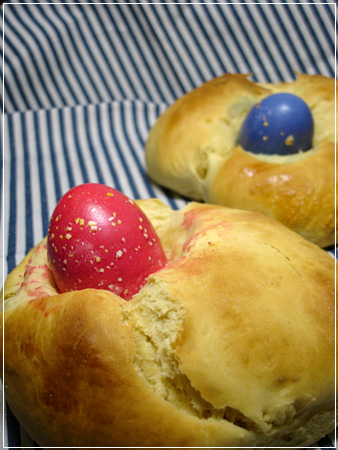
In Austria they eat Pinzen, which are small breads (surprise, surprise) that are sweetened and butter- or marmalade-flavored. They sell them at EVERY bakery.


And just like in the US, the Easter bunny brings Austrian kids lots of eggs and candy. Especially Lindt Goldhasen. 

I received three of these chocolate rabbits from various teachers and students. Some one couldn't help herself and ate the ears off of one on the way home from school. This is why the ears and head are strangely crinkled.

This last part isn't actually different from what happens in the US.